When scaling interactive corporate broadcasts, choosing the right streaming architecture is critical for both performance and budget. If you are comparing WebRTC and Livery, you need to look at how each infrastructure handles mass distribution. Here are the core operational differences between WebRTC and Livery for professional, high-volume live video.
| Feature / Metric | Livery (ULL-CMAF Architecture) | Standard WebRTC Solutions |
|---|---|---|
| Infrastructure Cost | 4 to 8 times more cost-efficient | High overhead due to dedicated media servers |
| Scalability | Millions of concurrent viewers via HTTP CDN | Severely limited and complex to scale |
| Enterprise Firewalls | 100% pass-through via standard HTTP/HTTPS proxies | Frequently blocked by corporate UDP restrictions |
| Hardware Load | Full hardware acceleration (Battery-efficient) | High CPU load causing mobile device overheating |
| Native Video Features | Out-of-the-box DRM, Subtitling, and ABR | Requires complex third-party integrations |
Deploying WebRTC at scale requires a highly specialized, dedicated media server infrastructure, which dramatically drives up operational costs. Livery, by contrast, leverages standard global HTTP CDN architecture, the same infrastructure trusted by major video-on-demand services. This allows Livery to distribute synchronized ultra-low latency streams at a fraction of the cost of WebRTC.
WebRTC was fundamentally engineered for peer-to-peer or small group communication. When expanding to large corporate audiences, WebRTC faces severe scalability bottlenecks due to complex server architectures. Livery bypasses these limitations completely by utilizing top-tier global CDNs. This ensures instant, cost-effective scalability across multiple global regions simultaneously, regardless of audience size.
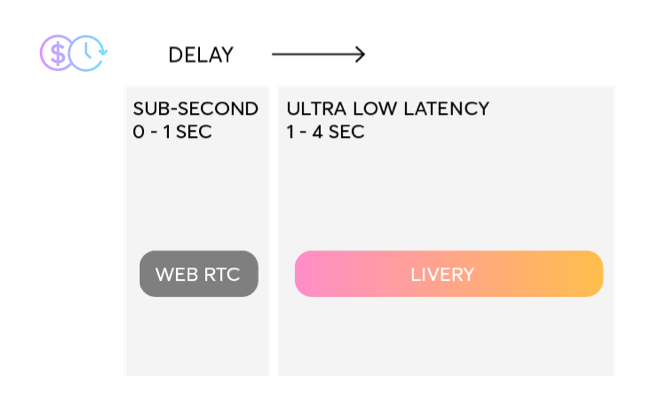
While WebRTC is an excellent protocol for niche use cases that mandate sub-second latency, such as remote surgery or interactive sports betting, that extreme speed comes with massive infrastructure costs. For 90% of enterprise use cases, a 3-second glass-to-glass latency combined with perfect synchronization offers a flawless user experience. By choosing Livery, you eliminate the massive overhead of WebRTC while maintaining real-time audience engagement.
Livery utilizes ULL-CMAF (Ultra-Low Latency Common Media Application Format), which unifies the stability of standard DASH and HLS streaming protocols with near real-time delivery speeds. This compliance allows Livery to natively support industry-standard enterprise features out of the box, including Digital Rights Management (DRM), multi-language subtitling, Server-Side Ad Insertion (SSAI), and Adaptive Bitrate Streaming (ABR).
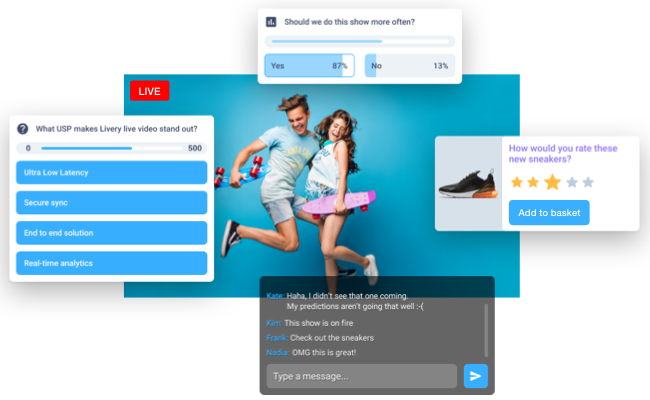
Adding interactive overlays to WebRTC streams requires complex, costly, and disjointed third-party integrations that frequently drift out of sync with the video feed. Livery unifies ultra-low latency video and an interactive layer into one single, cohesive framework. We provide plug-and-play interactive modules managed directly from an intuitive backend panel.
Because Livery relies on segment-based HTTP streaming, it seamlessly integrates with all major global video advertising networks, ad exchanges, and SSAI frameworks. WebRTC’s non-segment protocol makes native ad insertion incredibly difficult out of the box. The Livery platform enables you to inject secure user telemetry into both the player and interactive layers, allowing for highly targeted sponsorships that maximize your ARPU. Additionally, we fully support pay-per-view (PPV) models and real-time in-video e-commerce.
Compared to WebRTC, Livery offers significantly higher video quality while utilizing less bandwidth, translating directly into lower operational costs for your organization. Viewers will also benefit from Livery’s ability to leverage full native hardware acceleration on any device. This implies a drastic reduction of the load on the CPU, preventing mobile devices from overheating and extending battery life during long enterprise broadcasts.
Securing uninterrupted streaming through strict enterprise firewalls is a major challenge for WebRTC, which frequently relies on UDP ports that corporate IT networks block by default. Livery eliminates this restriction entirely by using standard HTTP/1.1 Chunked Transfer Encoding. Because corporate proxies are configured to natively support standard HTTP traffic, your live stream passes through corporate firewalls securely and without interruption, effortlessly maintaining high data volumes for enterprise viewers.
We offer a 20-minute live demo to experience Livery.
Select your preferred date or click here to get a first impression.